Many first-time homebuyers realize a single-family home is beyond their budget, or they don't have time to maintain a large property. While it may not be your first thought, financing a condo with a USDA loan may be a great alternative.
These loans stand out because they require no down payment and offer competitive interest rates compared to conventional loan options. These benefits appeal to first-time buyers or those without significant savings.
In a Nutshell
You can get a condo with a USDA loan as long as they meet standard USDA loan requirements. Eligible condominiums must be in USDA-approved rural areas, be in decent condition and be featured on an approved list by the Department of Housing (HUD), Fannie Mae or Freddie Mac.
What Counts As a Condo?
A condominium, or condo, is a home where you own your individual unit but share ownership of common areas with other residents. This makes condos distinct from apartments, which are typically owned by a landlord and rented out, and also from townhomes or duplexes, where owners often own the surrounding land or share a building structure.
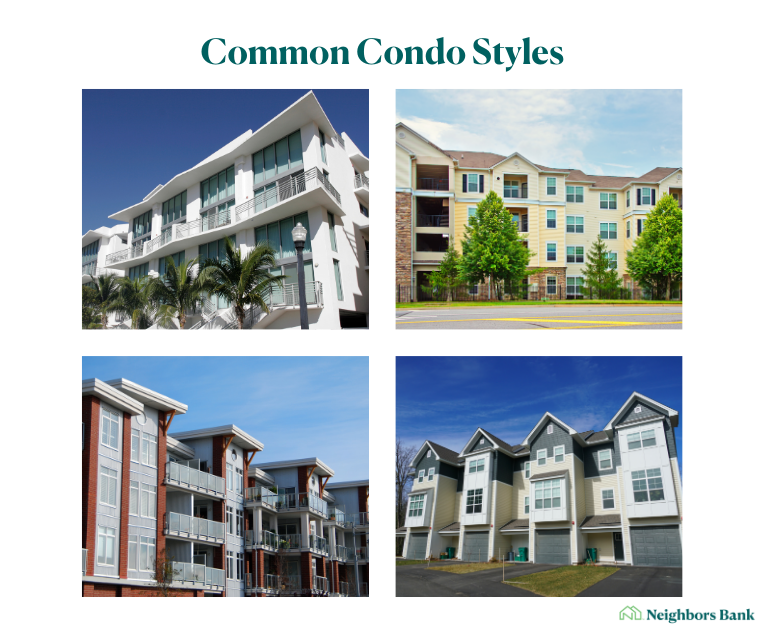
Neighborly AdviceDue to the lack of condominiums in rural areas, it can be difficult to find this type of home. If you are interested in pursuing a condominium over a traditional single-family home, it’s a good idea to work with a lender and real estate agent familiar with condo approval requirements.
USDA Loan Approval Requirements For Condos
When searching for a suitable condo to finance with a USDA loan, several requirements must be met.
Borrower Eligibility
For USDA condo financing, lenders will first verify that you qualify as a borrower. This includes meeting USDA income limits, credit requirements and occupying the home as your primary residence. Neighbors Bank typically requires a minimum credit score of 620 for USDA loans.
Lenders also want to ensure that you and any household members are the only occupants of the condo. This means you intend to use the home as a primary residence and not as a rental or vacation property to generate income.
Property Eligibility
As previously mentioned, the condo must be in an area designated as "rural" by the USDA. This might sound limiting, but many are surprised to learn that large portions of the U.S., including areas near bustling cities, are designated as "rural" by the USDA. Our property eligibility map can help determine if the condo is in a qualifying area.
The condo must also be safe and sanitary. For your lender to consider the property acceptable, its condition must be certified as structurally safe and sound according to USDA minimum property requirements.
Lastly, the condo must appear on at least one of the approved condo lists of the Department of Housing (HUD), Fannie Mae or Freddie Mac, indicating that the property will meet all standards previously mentioned.
Condo Properties That Are Ineligible for USDA Loans
Not all condo types will qualify for a USDA loan. Timeshares, investment properties, and any condos that are not intended to be primary residences are ineligible.
Another key restriction involves condo complexes with high concentrations of units owned by a single individual. This creates increased financial risk for lenders because the complex is more likely to experience instability if investors rent out or sell multiple units at once. When ownership is too concentrated, the condo may be classified as non-warrantable.
A non-warrantable condo no longer meets the approval standards from HUD, Fannie Mae or Freddie Mac. Since USDA loans depend on the approval of those agencies, non-warrantable condo complexes are not eligible for USDA financing.
Where to Find USDA-Approved Condos
If you’re in the process of searching for USDA-approved condos, then it’s important to know that the USDA does not have its own condo approval list. Instead, most lenders rely on approval lists from other major government agencies.
To find a condo that may qualify:
Start your search on listing sites. Filter your search to condo units on Zillow, where you can filter by price and location within eligible rural communities.
Verify the property address on the USDA map. Once you find a potential property, plug the address into the USDA property eligibility map to confirm it’s eligible for USDA financing.
Check the condo project on approved agency lists. After you confirm the location, search the condo’s legal name or project on an approved condo list.
How to Apply for a USDA Loan for a Condo
Applying for a USDA loan for a condo follows a procedure similar to other property types. Most importantly, your income must fall below the USDA-specified limit, and your debt-to-income ratio must be acceptable.
The key differences from a USDA loan for a single-family home vs. a condominium are:
If the condo has a Homeowner's Association (HOA), all HOA dues will be factored into your debt-to-income ratio during the underwriting process. This can influence both the buying power and the eventual monthly mortgage costs.
Your lender will need to perform an underwriting review of the condo to ensure it's been approved by HUD, Fannie Mae or Freddie Mac and that it's in compliance with all USDA rural eligibility guidelines. If all is well, your lender will issue a certification to the USDA proving the condo project meets all requirements.
If a USDA loan for a condo sounds right for you, Neighbors Bank can help you explore your options with a team that specializes in USDA lending and supports you through the entire process.


Emily Kittle is an experienced underwriter with a strong background in risk assessment, training, and loan decision-making. She excels at solving complex mortgage challenges and guiding loans to closing using creativity and critical thinking.