Saving for a down payment is an important part of preparing to buy a home, but deciding how much to save isn't always straightforward. A larger down payment can offer benefits, while taking more time to save means continuing to pay rent and potentially facing changes in home prices. The right balance depends on a homebuyer's budget, loan options, and local market.
To help homebuyers understand those trade-offs, Neighbors Bank compared buying with a smaller down payment against waiting to save 20% of the home price, modeling the two paths nationally across a range of low- and no-down payment loans. Neighbors Bank also surveyed more than 1,000 recent and prospective first-time homebuyers about what they believe a down payment has to be, how long they expect to save, and how they view mortgage insurance. VA loans are available only to eligible Veterans and military borrowers, and USDA loans, while open to the general public, require buying in an approved rural area and meeting income limits.
The research found gaps in homebuyers’ understanding of their options, alongside financial outcomes that consistently favored buying sooner for homebuyers using low- and no-down payment loans. Clear information about upfront costs and long-term expenses can help homebuyers decide whether to keep saving or explore a smaller down payment.
These results are from a hypothetical model, not actual borrower outcomes. They rely on assumptions about home prices, rent, interest rates, and savings returns that may not match your situation or market. Your results will depend on your finances, location, loan terms, and eligibility. This is not an offer of credit or a commitment to lend.
Key Takeaways
In the base case, each year of waiting beyond the time it takes to save 20% of the home price costs a modeled household about $10,000 in net worth (their home equity plus savings and investments) over the following ten years.
In this model, for a household starting with about $24,000 saved, the loans that ask for little or nothing down made buying sooner the stronger financial outcome. Whether that holds for any individual depends on their finances, location, and loan terms.
In the scenario we modeled, every low- and no-down payment loan tested, VA, USDA, FHA, and a 3% down conventional loan, left a homebuyer ahead of waiting to save 20%.
About 7 in 10 U.S. homebuyers (71%) think it takes five years or more to save a 20% down payment.
Nearly 3 in 5 homebuyers (59%) don’t know that eligible homebuyers can buy a home with no down payment through a VA or USDA loan.
About 3 in 5 homebuyers (62%) have put off buying a home to save for a 20% down payment.
Nearly 3 in 10 homebuyers (29%) believe they must put down at least 20% to get a mortgage.
About 1 in 8 homebuyers (13%) don’t know what mortgage insurance is.
How Loan Choice Changes the Down Payment Trade-off
The financial outcome of buying sooner or continuing to save depends on more than just the down payment. In Neighbors Bank’s model, loan costs and home price growth helped determine which approach resulted in greater net worth for a household after 10 years. The model compares a homebuyer who buys now with a small down payment against one who rents and saves toward a 20% down payment.
Both households start with about $24,000 saved, enough to cover closing costs but well short of 20% down, the situation many first-time homebuyers are actually in, buy or rent a typical $368,697 U.S. home, and put the same amount toward housing each month. Both households start with little saved, the situation many first-time homebuyers are actually in, and put the same amount toward housing each month.
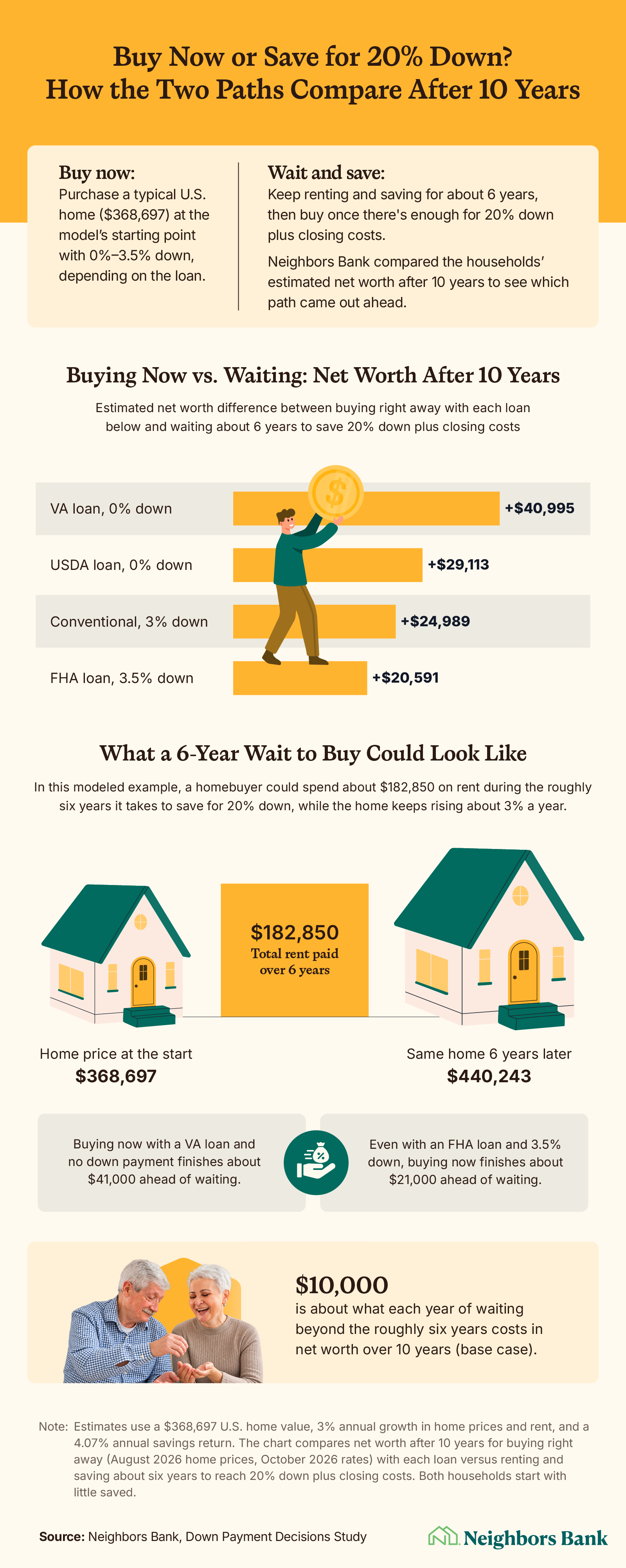
Because the household begins with little saved, reaching a 20% down payment plus closing costs took about six years, during which the household kept paying rent that rose about 3% a year. The 3% annual increase in home prices is a base-case assumption rather than a forecast; the model also tests 1% and 5%.
After 10 years, every low- and no-down payment loan left the homebuyer who bought sooner ahead of the one who waited. Buying now with a VA loan and no down payment finished about $41,000 ahead, a USDA loan about $29,000 ahead, a 3% down conventional loan about $25,000 ahead, and an FHA loan about $21,000 ahead. Buying now with no down payment, through a VA or USDA loan for eligible homebuyers, produced the largest advantage because it let the household stop renting immediately. Many homebuyers also use down payment assistance to help cover upfront closing costs, which can make buying sooner possible even for those who haven’t saved much.
These modeled outcomes show why a down payment target alone doesn’t settle the decision. For a homebuyer starting with about $24,000 saved, the home loans that ask for little or nothing down can make buying sooner the stronger financial move.
Down Payment Knowledge Gaps Leave Options Unexplored
Knowing how much a loan requires upfront can help homebuyers set a savings goal. The survey found that some respondents believed a 20% down payment was required, while others were unfamiliar with options that could require less.
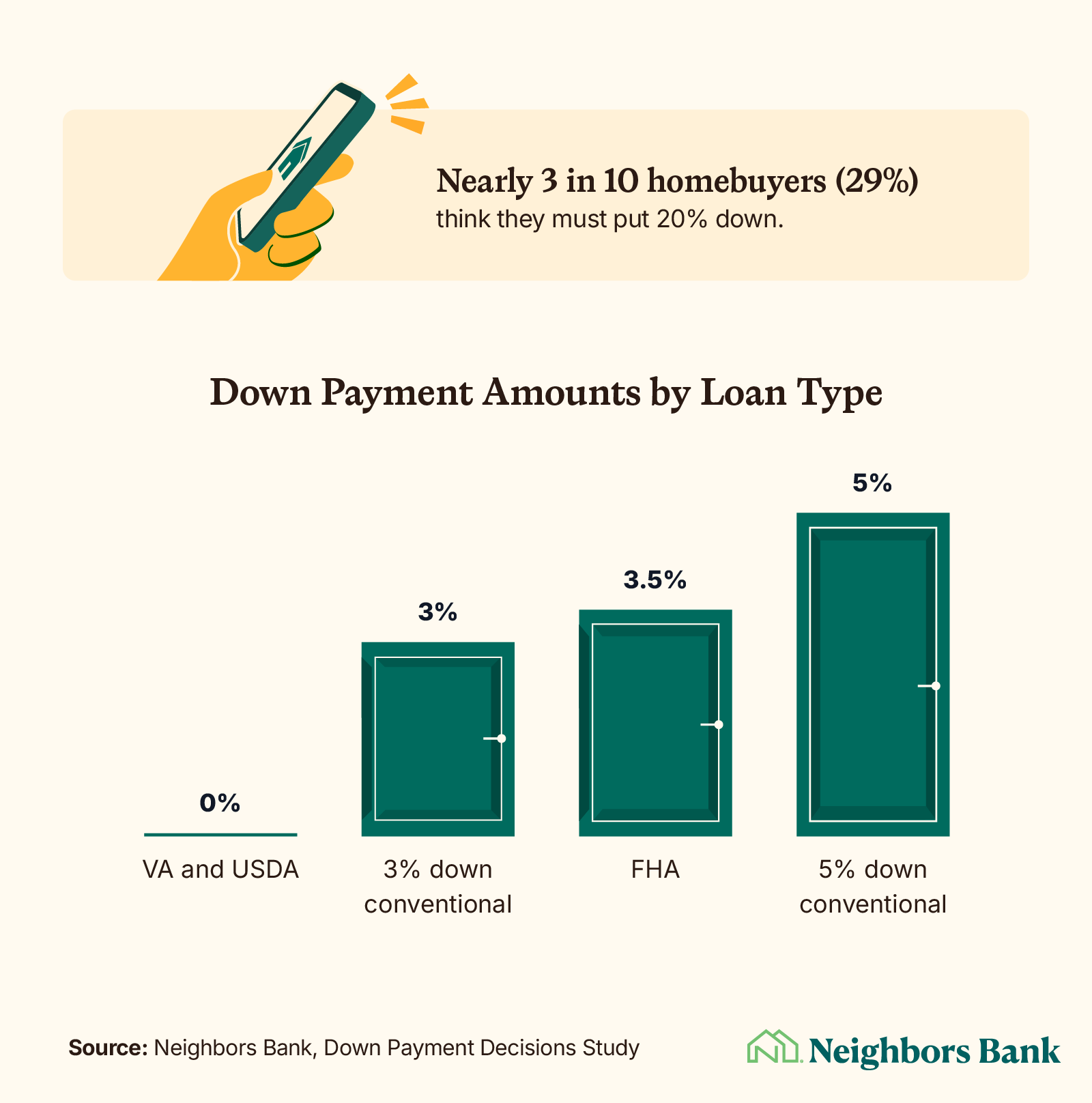
Nearly 3 in 10 recent and prospective first-time homebuyers (29%) believed they needed to put down at least 20% to get a mortgage. Among those earning under $50,000, that share was 38%.
Awareness of alternatives was limited. About 3 in 5 respondents (59%) didn’t know that eligible homebuyers could purchase with no down payment through a VA or USDA loan, and 1 in 5 weren’t aware of any of the low or no down payment options listed in the survey.
Younger respondents reported some of the largest knowledge gaps. Just 29% of Gen Z knew about VA or USDA no down payment options, compared with 51% of Gen X. Another 29% of Gen Z weren’t aware of any of the listed options.
Among those in military-connected households, 39% didn’t know that a VA loan could require no down payment. Across all respondents, only 13% said they understood VA loans well enough to explain them, and 11% said the same about USDA loans.
Lenders can help clear up confusion by explaining minimum down payments, eligibility requirements, and total loan costs before homebuyers set a savings target.
Saving Goals Come With Concerns About Rent and Home Prices
Building a down payment takes planning, especially while paying for current housing. Respondents shared how saving affected their homebuying timelines and how they felt about the costs along the way.
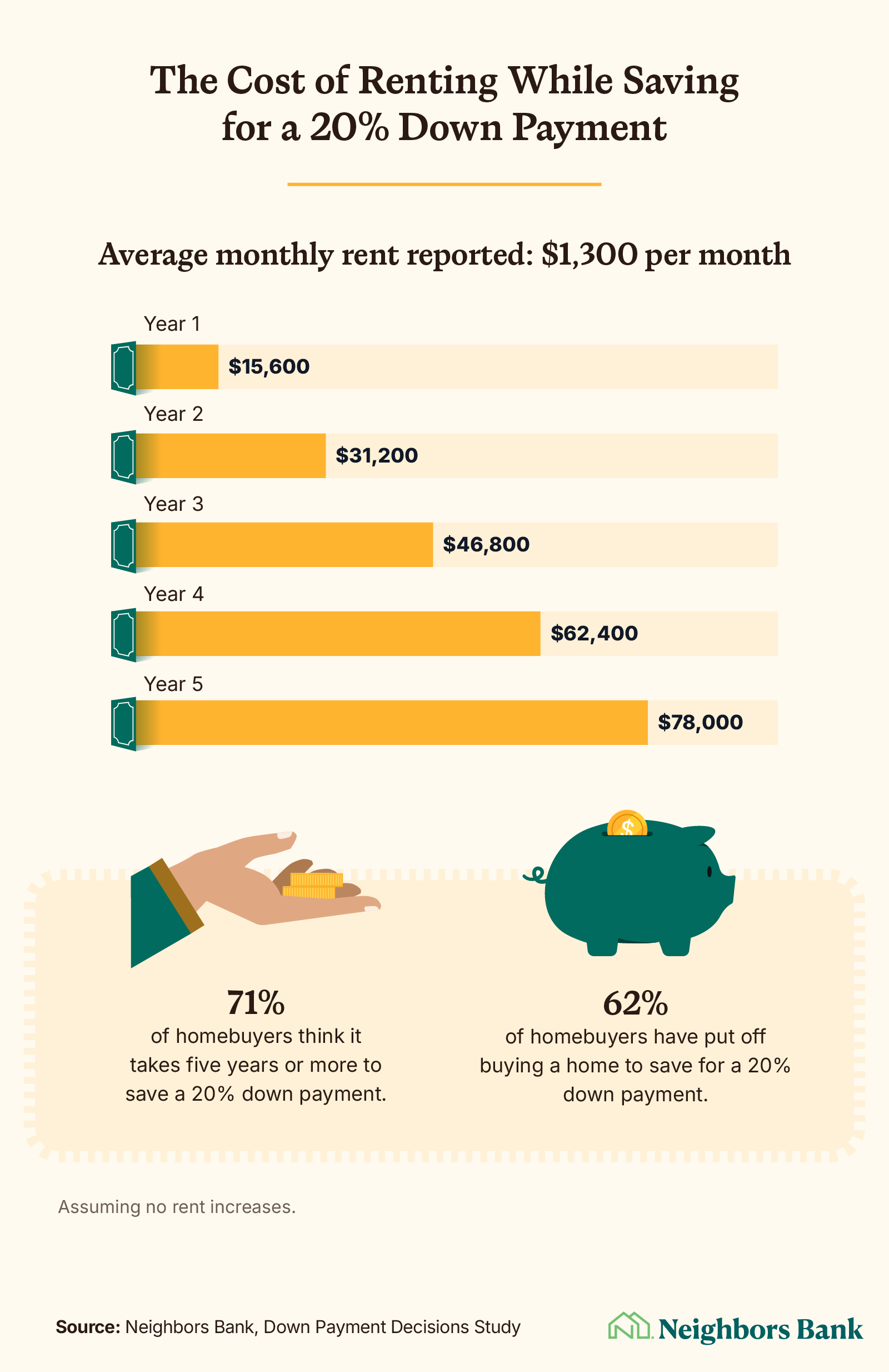
Respondents reported typical rent payments of about $1,300 a month while saving. At that amount, rent would total $15,600 over one year or $78,000 over five years, assuming no increases. About 1 in 4 homebuyers (26%) have put off buying for three years or longer. The national model above uses a higher figure, $2,289 a month in single-family rent from Zillow, so the two rent amounts differ.
About 3 in 5 respondents (60%) felt that renting longer while saving meant wasting more money, and 61% worried home prices would rise faster than their down payment savings. The share who viewed renting while saving as wasteful was 65% among women and 55% among men.
Mortgage Insurance Costs Can Be Hard to Anticipate
Respondents had different views on paying mortgage insurance, and some weren’t familiar with it. Recent homebuyers also reported differences between expected and actual costs.
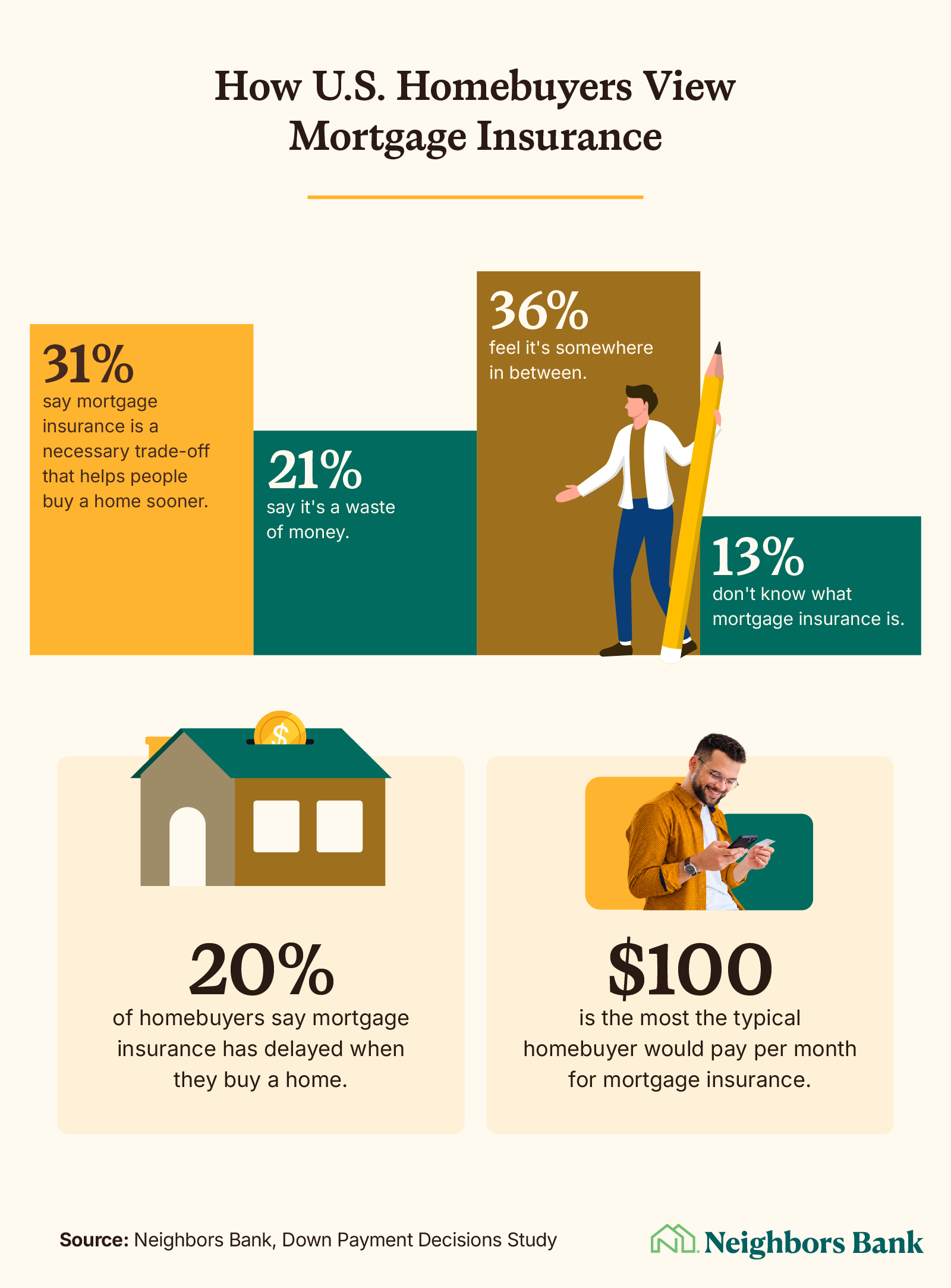
The survey asked homebuyers about mortgage insurance in the forms they’d most often encounter, private mortgage insurance on a conventional loan and FHA mortgage insurance. Homebuyers were split on whether mortgage insurance is worth paying. About 3 in 10 (31%) called it a necessary trade-off that helps people buy a home sooner, while 21% called it wasted money and 36% landed somewhere in between.
About 1 in 8 homebuyers (13%) didn’t know what mortgage insurance is. That share rose to about 1 in 6 Gen Z homebuyers (17%), the highest of any generation. Future homebuyers were much more likely to be unsure about what mortgage insurance is, at 18% compared with 5% of recent homebuyers.
The typical maximum amount respondents said they would feel comfortable paying for mortgage insurance was $100 a month. Mortgage insurance costs had delayed home purchases for 1 in 5 respondents. When asked which costs more over five years, 46% said renting while saving for a 20% down payment, and 24% said buying now with a 5% down payment and mortgage insurance. The study’s own numbers lean toward the 46%: nationally, buying with a small down payment and paying mortgage insurance finished slightly ahead of renting and saving over five years.
More than 1 in 3 recent homebuyers (36%) said mortgage insurance cost more than they expected, and more than 1 in 10 (12%) said they had no idea what it would cost before buying. Looking back, 39% of recent homebuyers would make a larger down payment, while just 10% would make a smaller one.
A Down Payment Goal Should Fit the Homebuyer
The 20% down payment has long been treated as the price of owning a home. Reaching it can mean years of rent and the risk that prices climb faster than savings, while the loans that ask for far less often go unnoticed.
For a homebuyer starting with modest savings, the model found that buying sooner with a low- or no-down payment loan came out ahead of waiting to save 20%, and that the no-down payment options came out furthest ahead. The right choice still depends on each homebuyer’s circumstances, but the study shows the decision deserves real numbers rather than a rule of thumb. Knowing what today’s home loan options actually require is the first step toward making it.
Methodology
Neighbors Bank surveyed 1,006 American adults ages 18 and older on October 8th, 2026. All had bought their first home in the past five years (377) or plan to buy one (629). The survey asked how much they believe they must put down, how long they expect to save, how they view mortgage insurance, and whether its cost has changed when they buy. Answers reflect their own beliefs and plans, not verified loan qualifications.
Here, mortgage insurance refers to private mortgage insurance (PMI) on a conventional loan with less than 20% down payment, or FHA mortgage insurance. VA and USDA loans may require no down payment for eligible homebuyers. Instead of mortgage insurance, VA loans charge a one-time funding fee, and USDA loans charge a one-time upfront guarantee fee plus an annual fee.
Some questions were asked only of recent homebuyers or only of future homebuyers, and those results are reported for that group. Dollar amounts for rent, savings, and acceptable mortgage insurance costs were cleaned of extreme values. Generationally, 24% were Gen Z, 56% were millennials, 18% were Gen X, and 2% were baby boomers, too few to report. Generation labels were based on reported age, and percentages may not total 100% because of rounding.
Neighbors Bank also modeled the cost of waiting. The model compares two identical households. One buys a typical U.S. home now with a small down payment and pays mortgage insurance or a loan fee. The other rents, invests its savings, and buys the same home after saving 20% of its risen price plus closing costs. Both are scored on net worth, their home equity plus savings and investments, after five, seven, and 10 years, across the low- and no-down payment loans a homebuyer starting with little saved could use: VA and USDA (no down payment), FHA (3.5% down), and a 3% down conventional loan. Both households begin with the same modest savings, enough to cover the cash to close, so the comparison reflects first-time homebuyers starting with little rather than a household already close to 20%. Because the household starts with little saved, reaching 20% plus closing costs takes about six years at a 4.07% return.
Home values and rents are from Zillow (mid-tier home value and single-family rent, August 2026). Mortgage rates are from Freddie Mac (7.03%) and Optimal Blue. Loan costs follow Fannie Mae pricing and PMI cancellation rules, Enact PMI rates, HUD's FHA premiums and loan limits, the VA funding fee, and USDA fees. Savings earn the 3-month Treasury rate of 4.07%, with 7% also tested. Property taxes and incomes are from the Census Bureau, and loan limits and home price history are from FHFA.
The base case assumes 3% annual home price growth, 3% annual rent growth, closing costs of 3% of the home price, 1.5% of home value per year for insurance and maintenance, and a 10-year horizon. Where a saver cannot reach 20% in time, the result is reported as such, not as a win for buying. USDA loans are limited to eligible rural and suburban areas and to households under income limits; the model does not apply those location or income rules. Every result was independently reproduced, and all figures are rounded.
About Neighbors Bank
Neighbors Bank is a home loan lender focused on making homeownership more affordable and accessible. The bank combines digital mortgage tools with personalized guidance to help homebuyers understand their financing options and the homebuying process.
Note: Down payment assistance programs offered through Neighbors Bank are provided by third parties and are subject to availability and eligibility. Program features can change.
Fair Use Statement
This content may be shared for noncommercial purposes only with proper attribution to Neighbors Bank. When referencing or reposting these findings, please include a link back to Neighbors Bank.