For many homebuyers, where a home sits in relation to family matters as much as the home itself, and sometimes, even more. Neighbors Bank surveyed 1,000 American homeowners to put a dollar figure on that choice and to better understand how cost affects where families put down roots.
The survey looked at how far people live from their immediate family today, what has kept them from moving nearer, and what would change their minds. Often, the deciding factor is money as much as feeling. A lender helps on that front, showing homebuyers what they can realistically afford and how a specific home fits their monthly budget before they make an offer.
Key Takeaways
33% of homeowners who haven't moved closer to family point to housing costs or mortgage rates, including home prices being too high in that area (19%), a higher cost of living in that area (17%), waiting for mortgage rates to come down (7%), and being locked into a current mortgage or unsold home (7%).
42% of homeowners would make a trade-off to live closer to family, from a smaller home (18%) to a longer commute (10%).
16% of homeowners are planning to move closer to family.
Homeowners live a median distance of 18 miles from their immediate family, and 44% wish they lived closer.
55% of Gen Z wish they lived even closer to family, despite already living closer than any other generation (10-mile median).
Nearly 1 in 5 homeowners who haven't moved closer (18%) would downsize their home if it meant closing the distance.
How Close Do Americans Live to Family?
For a majority of American homeowners, family proximity is a factor they're actively weighing when making housing decisions and often acting on.
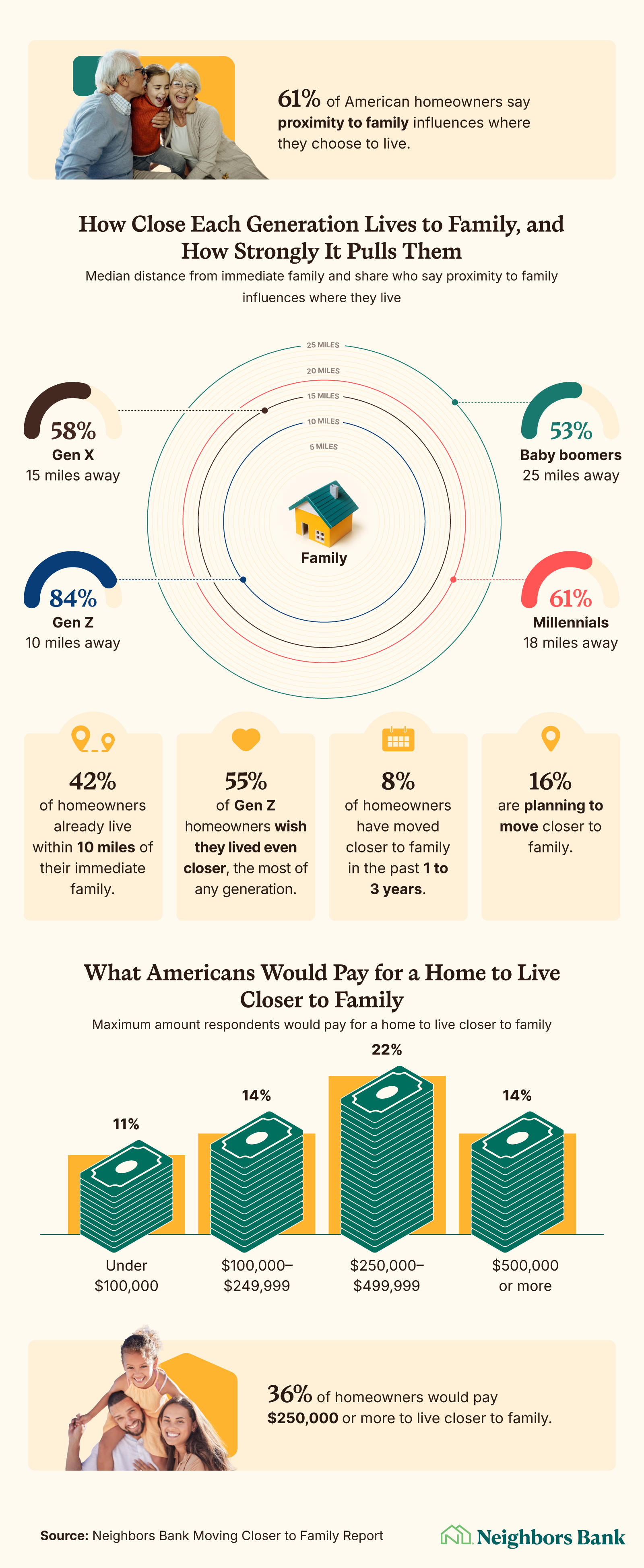
The typical homeowner lives 18 miles from their immediate family, and more than 2 in 5 (44%) say they wish they lived closer. That gap is closing for some: 8% of homeowners have moved closer to family in the past 1 to 3 years, and another 16% say they're planning to do so. Gen Z lives closest to their immediate family (within 10 miles), while baby boomers are the furthest away (25 miles). More than 1 in 3 homeowners (36%) say they'd pay $250,000 or more for a home if it meant living closer to family.
What It Would Take to Close the Distance
Homeowners who haven't yet moved closer to family usually want to do so. What holds them back tends to be financial rather than personal. Neighbors Bank asked what kind of offer would change that, and the responses show how much relocation depends on the numbers.
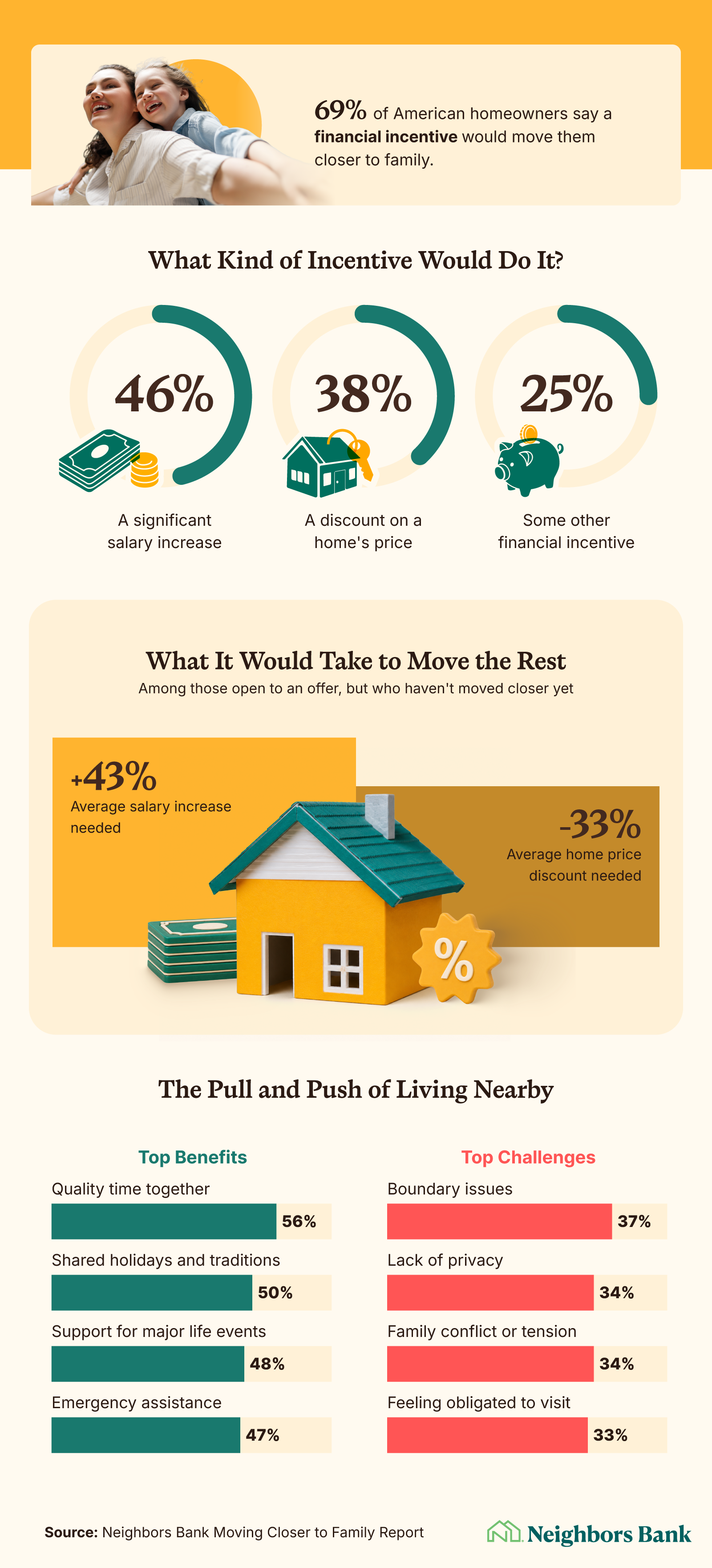
Among homeowners who are open to relocating but haven't yet made the move, the average threshold is a 43% salary increase or a 33% discount on the home price. Those figures show how large people believe the affordability gap has become in the markets where their families already live. In practice, closing that distance can cost far less than it looks. Low and no down payment options and down payment assistance can reduce the cash a homebuyer needs upfront.
Incentives to move closer to family aren't always just financial. Homeowners who already live near family say the best benefits are quality time together (56%), shared holidays and traditions (50%), a built-in support system for major life events (48%), and access to emergency assistance (47%). Those upsides help explain why so many homeowners say they would accept the tradeoffs covered next.
What Homeowners Will Trade to Live Closer
For homeowners who haven't made the move, cost is usually what stands in the way. But many say they're willing to give something up to shorten the distance, and the survey shows just how much.
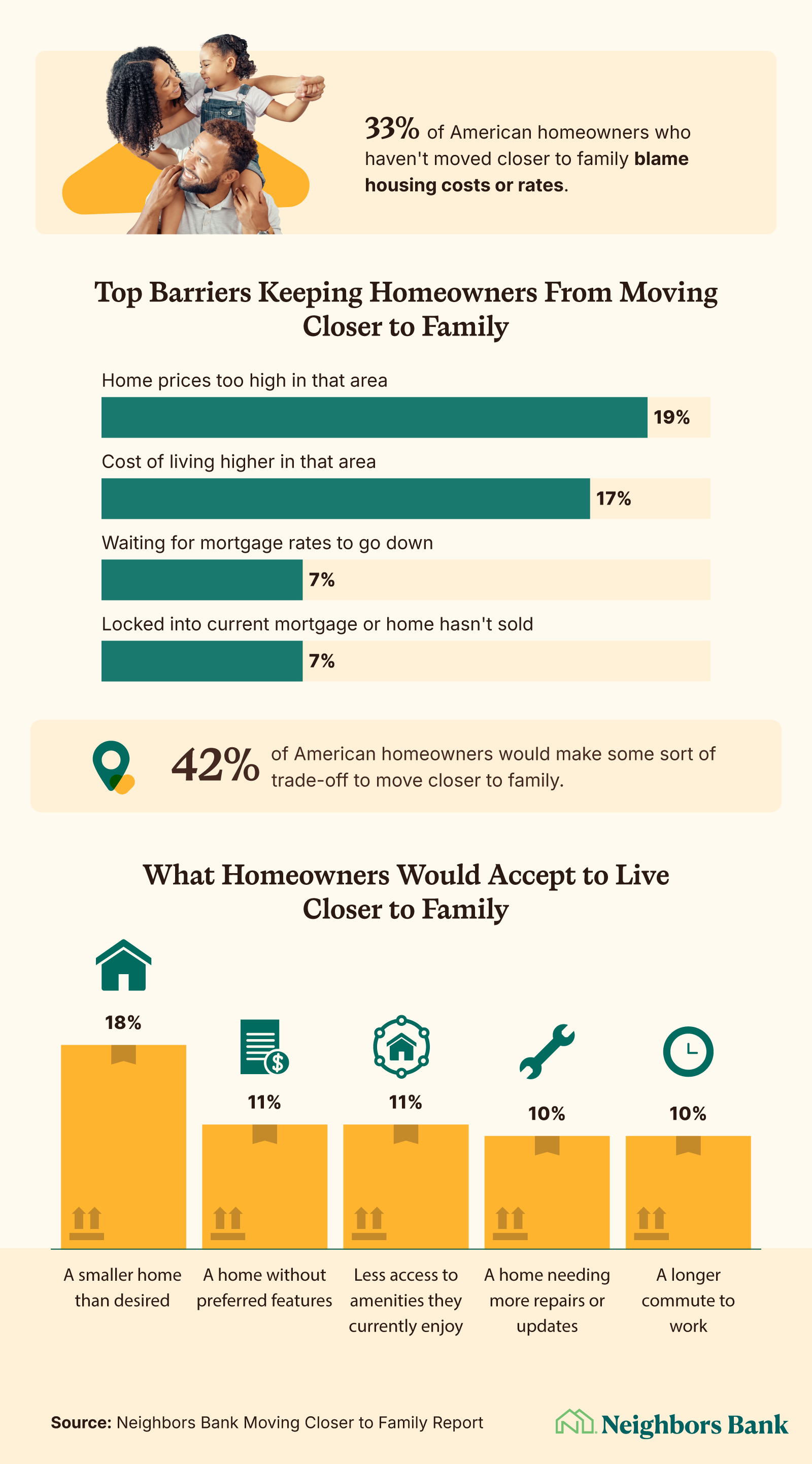
A third of homeowners who haven't moved closer to family point to housing costs or mortgage rates as the reason. The top barrier is home prices being too high in the area where their family currently lives (19%).
Overall, more than 2 in 5 homeowners (42%) say they'd make some kind of tradeoff to move closer to family. A smaller home is the most common concession (18%), followed by giving up preferred home features (11%), and accepting less access to amenities (11%). Nearly 1 in 5 of homeowners who haven't yet moved (18%) also say they'd be willing to downsize.
The encouraging part is that homeowners may not have to sacrifice as much as they expect. A lender can walk through how different loan options and locations affect the monthly payment, so a home near family may fit the budget with fewer compromises needed.
Proximity Is Now Part of the Affordability Equation
For homeowners weighing a move closer to family, the decision rests on the same factors behind any home purchase. What a home costs and what rate a homebuyer qualifies for set the budget, and how much room there is to adjust on size or location often decides whether the move works. Family proximity is not competing with affordability so much as it has become part of it, a factor homebuyers price into where and when they buy.
Much of that flexibility comes from the financing itself. A large down payment is not the only way into a home, and for a family trying to close the distance, the right loan structure can matter as much as the asking price. Down payment assistance programs can reduce the cash a homebuyer needs upfront, and programs such as HomeReady® and Home Possible® are built to make conventional financing more accessible for qualifying low- to moderate-income homebuyers. For a move to a suburban or rural area near family, a USDA loan offers 0% down payment financing on eligible homes, while an FHA loan can be one of the easier paths to qualifying for homebuyers without a large amount saved.
The most useful step is comparing the full cost of each option, including the down payment, closing costs, mortgage insurance, interest rate, and monthly payment. A knowledgeable lender can run those scenarios side by side and help a homebuyer find a path to living closer that fits both what they can afford now and what they are comfortable paying over time.
Methodology
Neighbors Bank surveyed 1,000 American homeowners between August 6 and August 7, 2026, to explore how proximity to family factors into homebuying decisions and see what people would pay or trade to close the distance. Respondents consisted of Gen Z (7%), millennials (46%), Gen X (33%), and baby boomers (14%). Percentages may not sum exactly to 100% due to rounding or to questions that permit multiple responses. Average figures exclude statistical outliers.
About Neighbors Bank
Neighbors Bank is a home loan lender dedicated to helping everyday Americans on the path to homeownership. Specializing in mortgage products designed for first-time buyers and those navigating major life transitions, Neighbors Bank combines competitive rates with a clear, guided process so buyers can make confident decisions about where, and how, to put down roots.
Fair Use Statement
The data and findings in this study are available for noncommercial use only. When referencing or republishing this research, please attribute the work to Neighbors Bank and link to the original article.
HomeReady® is a registered service mark of Fannie Mae. Home Possible® is a registered trademark of Freddie Mac.