First-time homebuyers in 2026 are approaching the market with more discipline than their uncertainty might imply. They are negotiating carefully, expanding their searches, and staying firm on price, all signs of homebuyers making thoughtful, informed decisions in a challenging market. Neighbors Bank surveyed 934 people who are either actively searching for their first home (76%) or purchased one within the past year (24%) to better understand how first-time homebuyers are navigating the process and where additional guidance could make a difference.
The findings point to a group that is already making smart, deliberate choices. The opportunity now is to help homebuyers feel as confident as their behavior shows they can be, starting with a closer look at where that confidence breaks down during the homebuying process.
Key Takeaways
86% of first-time homebuyers are comfortable offering below a home's asking price, and 57% have walked away from a home when they had the negotiating power to do so.
The most common move first-time homebuyers are making is expanding their search radius (54%), and 88% are open to buying outside a major metro to find an affordable home.
About half (51%) expect their monthly mortgage payment to be similar to or lower than what they currently pay in rent.
38% expect to need 10% or more for a down payment, yet 22% have never heard of low or no down payment loan programs.
A price reduction is the seller concession that would most boost first-time homebuyers' confidence to move forward (40%).
Where First-Time Homebuyers Have Leverage
Leverage shows up in what homebuyers are willing to do. First-time homebuyers are making offers below asking, walking away when the numbers do not work, and looking beyond their initial search area to find the right deal. After years of bidding wars and waived contingencies shaping the market, many buyers are becoming more comfortable setting their own limits.
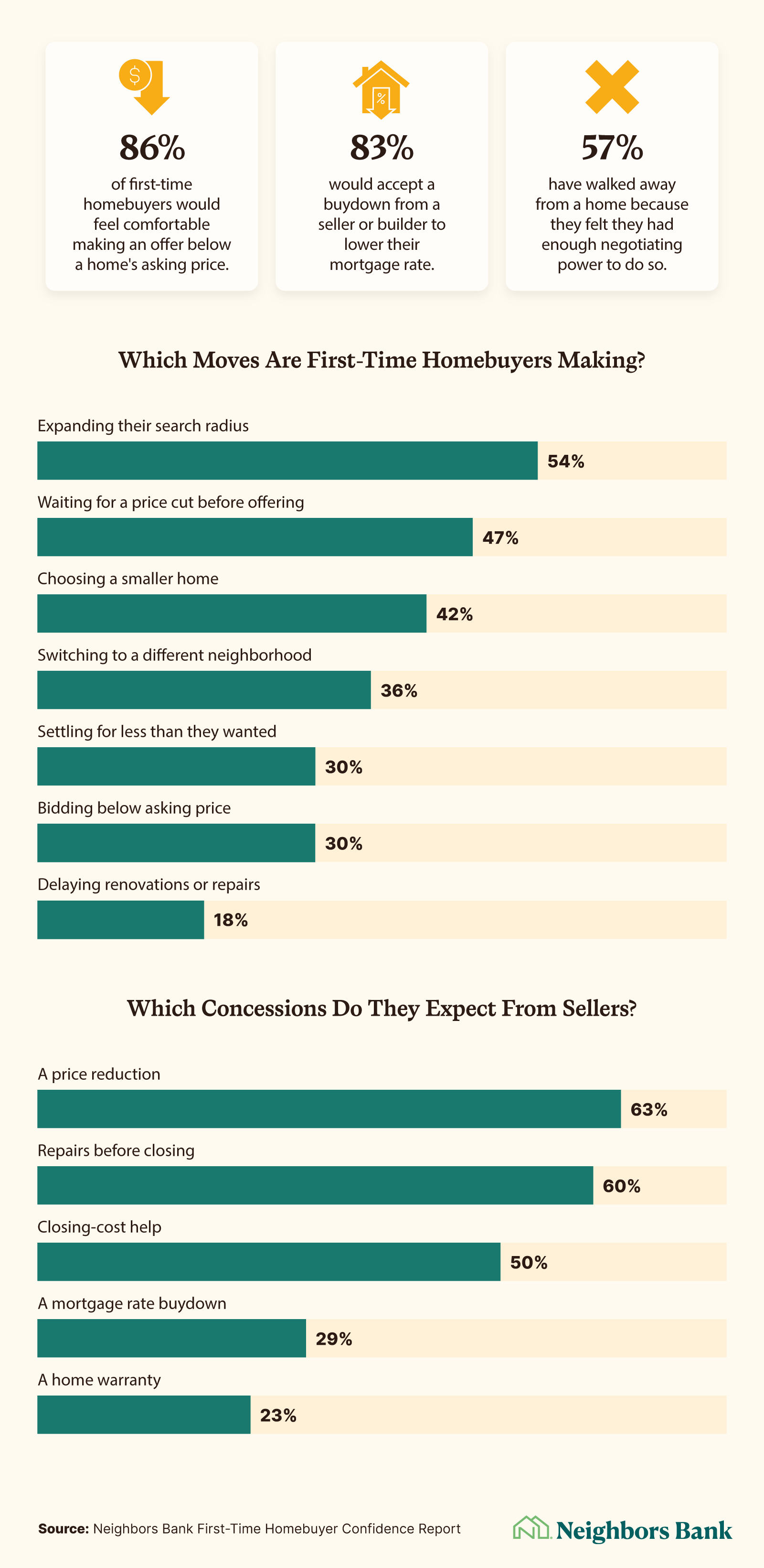
More than 4 in 5 first-time homebuyers (86%) are comfortable offering below asking, and 83% would accept a mortgage interest rate buydown from a seller or builder. More than half (57%) have walked away from a home rather than overpay. Expanding their search radius (54%) and waiting for a price cut before making an offer (47%) are also among their most common strategies. Buyers are looking for value, and they know there can be more than one way to get it. Price reductions top the list of seller concessions they expect (63%), followed by repairs before closing (60%) and help with closing costs (50%).
For first-time homebuyers, it's important to understand which of those concessions will have the greatest impact on their finances. A lower purchase price is valuable, but it is not always the only, or even the most meaningful, way to reduce the cost of buying a home. Seller-paid closing costs can reduce the amount of cash a buyer needs upfront, while an interest rate buydown can lower the monthly mortgage payment, depending on the loan structure and the offer. That makes it worth looking at the full financial picture rather than negotiating on price alone.
A lender can help homebuyers compare those tradeoffs, understand how different concessions affect their upfront and monthly costs, and determine which combination makes the most sense for their budget. In a market where homebuyers have more room to negotiate, knowing what to ask for can be just as valuable as knowing when to walk away.
Homebuying Confidence Hasn't Caught Up
Here is the disconnect: the same homebuyers making confident moves do not feel confident making them. Only about 1 in 5 (21%) say now is a good time to buy, and just 27% feel in control of the process. But the worry is more about getting a decision wrong than about buying. Overall, 69% say every homebuying decision feels too risky to get wrong, while only 9% feel it is too risky to move forward with a purchase right now.
First-time homebuyers, in other words, are not frozen. They are careful and looking for a knowledgeable partner to help them get the details right.
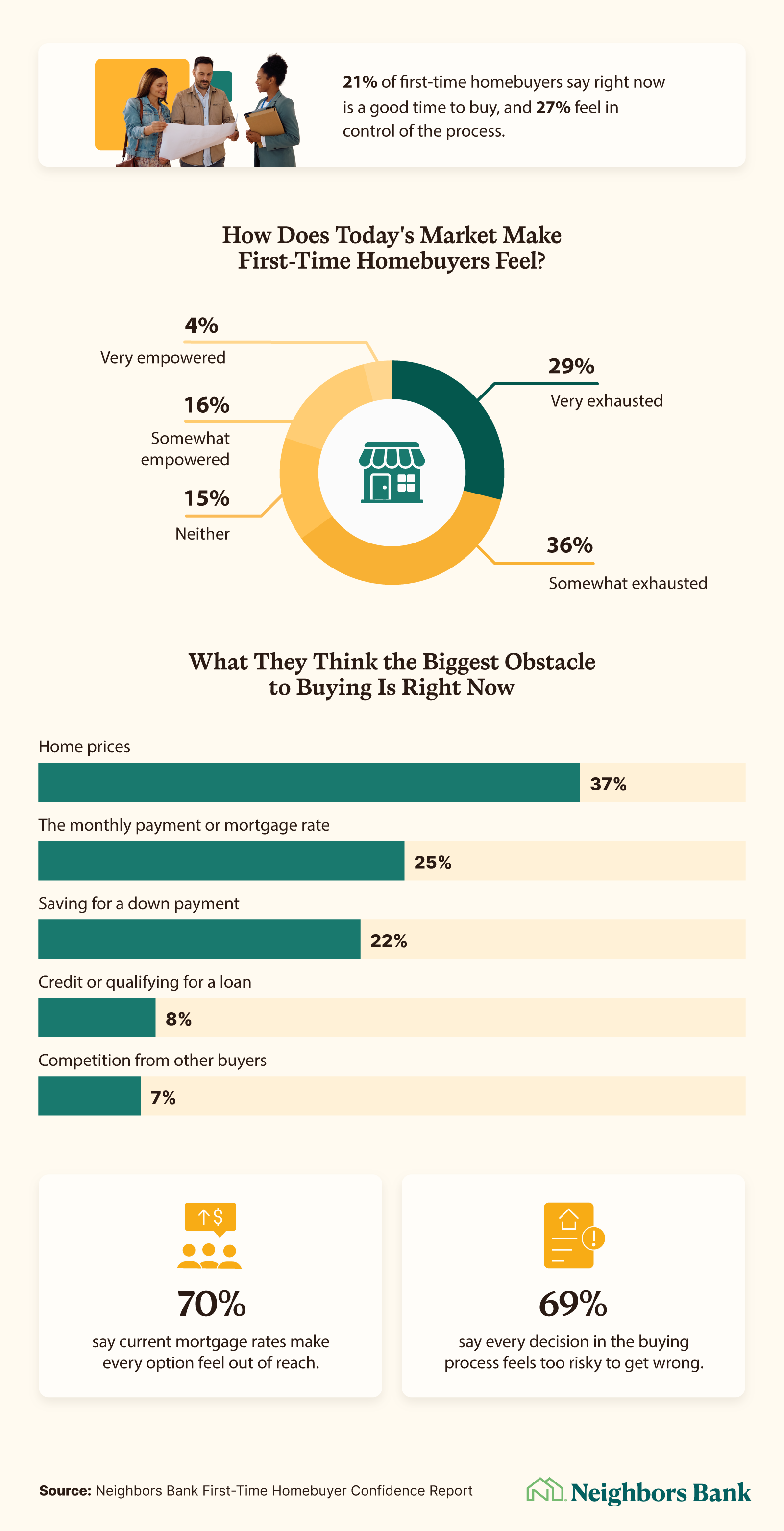
When homebuyers name what weighs on them, mortgage rates loom largest: 7 in 10 say current rates make some options feel out of reach. Yet the rate making headlines is not necessarily the rate a homebuyer will qualify for, nor does it tell them what a home will ultimately cost each month. Credit profile, loan type, down payment, purchase price, and available seller concessions can all affect the equation. Looking at today's mortgage rates alongside those factors gives homebuyers a much more useful picture than focusing on a single national average.
Waiting for rates to fall can also come with a tradeoff. If home prices rise in the meantime, some or all of the savings from a lower future rate could be offset by a higher purchase price. More than a quarter of first-time homebuyers (26%) already recognize that possibility, saying their biggest concern is waiting to buy only to see prices climb again. Whether buying now or waiting makes more financial sense depends on the buyer, the home, and market conditions, which is why running the numbers for both scenarios can be more useful than trying to time the market perfectly.
This is where a clear budget does more than any market forecast. Once a first-time homebuyer knows what they can realistically afford and which loan fits their situation, much of what feels too risky to get wrong becomes a plan they can act on at their own pace.
What Would Close the Confidence Gap
The survey also shows what could move first-time homebuyers from hesitation to action, and many of those opportunities may be more attainable than they think.
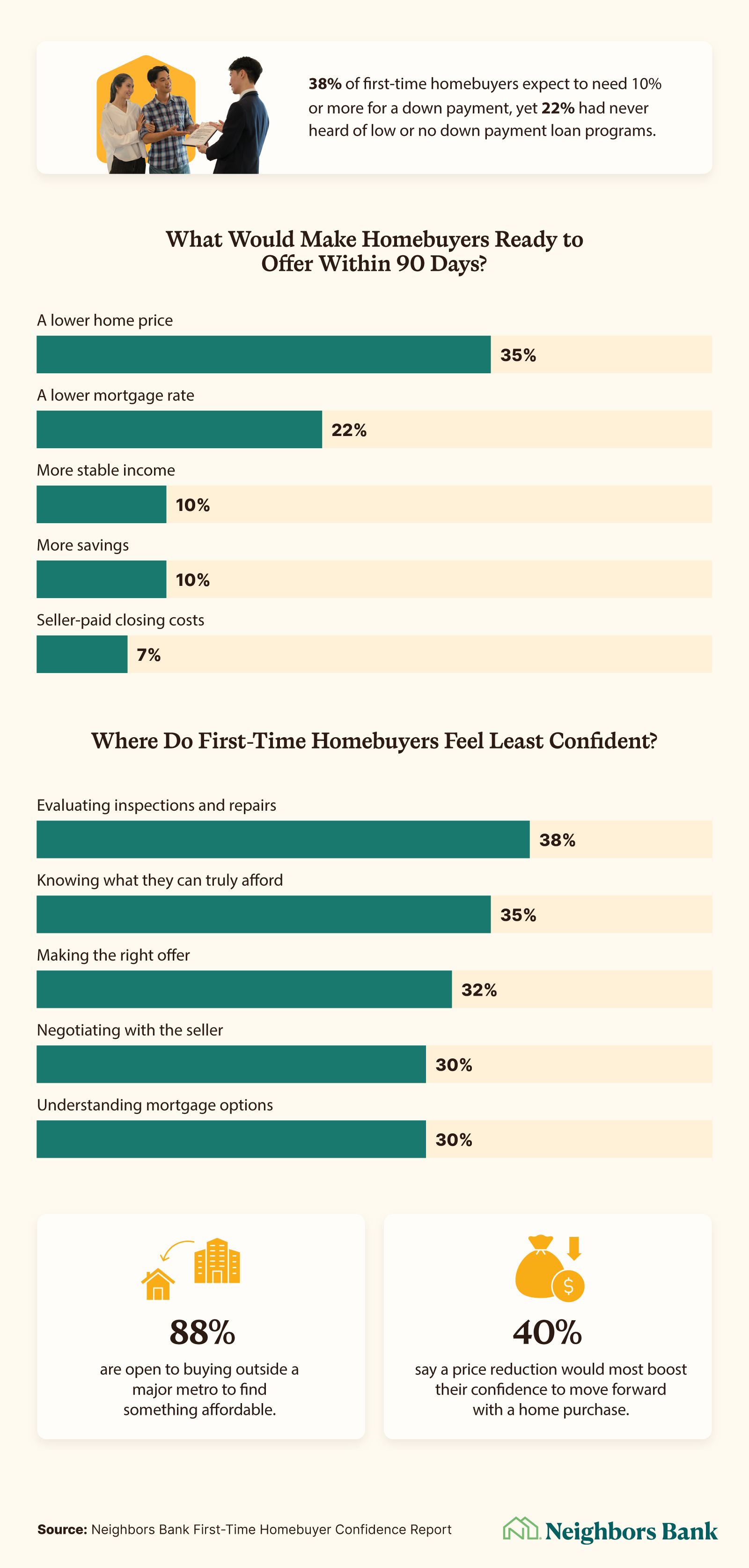
Affordability leads, and homebuyers are flexible about how they reach it. Nearly 9 in 10 (88%) are open to buying outside a major metro to find a more affordable home. About half (51%) expect a monthly payment similar to or lower than their current rent. When compromises are necessary, homebuyers are most willing to accept a higher monthly payment (24%) or a less ideal location (19%).
The willingness to look beyond city limits points straight to one of the most overlooked options on the market, USDA loans. These loans are built for exactly this type of move, offering 0% down payment financing on homes in eligible suburban and rural areas. And yet more than 1 in 5 first-time homebuyers (22%) have never heard of a low or no down payment program.
That knowledge gap matters because a 20% down payment is far from the only path to homeownership. Depending on eligibility, buyers may be able to use down payment assistance programs or closing cost assistance to reduce the cash needed upfront. Programs such as HomeReady® and Home Possible® are designed to make conventional financing more accessible for qualifying low to moderate income borrowers. Comparing an FHA loan with a conventional loan or exploring FHA down payment assistance can also help homebuyers understand which route best balances upfront costs with an affordable monthly payment.
The important step is not simply finding the loan with the smallest down payment. It's comparing the full cost of each option, including the down payment, closing costs, mortgage insurance, interest rate, and monthly payment. A knowledgeable lender can run those scenarios side by side and help homebuyers understand which financing structure fits both what they can afford today and what they are comfortable paying over time.
A First-Time Homebuyer's Story
Neighbors Bank worked with a first-time homebuyer in Virginia who had a limited credit history and had not yet paid rent on his own, so buying a home felt like a stretch. Neighbors Bank looked to the USDA loan to help him buy in the suburbs, and that changed everything. He was able to find a home with a 20-minute commute to work and nearly two acres of land, all with a $0 down payment.
His credit even dipped during the homebuying process, but it all worked out. The right lender will work with homebuyers to get them back on track before closing, when it's possible. This first-time homebuyer didn't have the perfect financial profile, but he didn't let that, mortgage rates, or outdated myths stop him from buying his first home.
Conclusion
First-time homebuyers are already doing many of the hard things right. They are negotiating, setting limits, considering different locations, and walking away when a deal does not make financial sense. What many are missing is a clear view of the financing options available to them and how those options change the math. That is where Neighbors Bank can help, giving first-time homebuyers the information and guidance to turn "maybe" into a homebuying plan built around what they can actually afford.
Methodology
This study is based on a survey of 934 U.S. first-time homebuyers, all prescreened to be either actively searching for their first home (76%) or to have purchased their first home within the last 12 months (24%). The generations were Gen Z (30%), millennials (56%), Gen X (13%), and baby boomers (1%). Respondents were 55% women and 43% men. Data was collected in July 2026.
About Neighbors Bank
Neighbors Bank works to make homeownership more affordable, accessible, and achievable for homebuyers. Neighbors Bank offers a full range of home loan options, including FHA, USDA, VA, and conventional loans, along with down payment assistance programs that can cover up to 100% of a buyer's down payment and closing costs. Neighbors Bank also ranks among the top 3 USDA lenders in the country.
For first-time and moderate-income homebuyers, Neighbors Bank pairs modern digital mortgage tools with one-to-one support, from credit-building help before preapproval to a dedicated team that keeps you in the loop through closing. Whether you're figuring out what you can afford or ready to apply, Neighbors Bank experts are here to help you find the right path to a home of your own.
Fair Use Statement
Feel free to share these findings for noncommercial purposes. If you reference this study, please provide attribution to Neighbors Bank and include a link back to the original source.