Buying a home has rarely felt harder to do alone. Home prices and mortgage rates remain elevated, and the median age of a first-time homebuyer has risen to 40, up from 38 a year earlier. Faced with those costs, a growing number of Americans are rethinking the idea that a home has to be bought alone or put off until marriage.
The makeup of buyers is shifting, too: married couples slipped to 61% of buyers as single and unmarried buyers gained ground. Many are now teaming up to get through the door. In a Neighbors Bank survey of more than 1,000 Americans, 71% said they would consider co-buying a home with a friend, sibling, parent or unmarried partner if it made ownership more affordable.
As a lender focused on making homeownership more affordable and accessible, Neighbors Bank wanted to understand how Americans are approaching that choice. The bank surveyed more than 1,000 Americans about who they would consider buying with, how affordability factors into those decisions and what protections they would want before sharing ownership.
Key Takeaways
71% of Americans would consider co-buying a home with someone other than a spouse if it made homeownership more affordable.
60% of Americans would rather co-buy and own half of a home now than keep renting until they can afford a home on their own.
About 3 in 5 Americans (61%) view co-buying a home with a close friend or family member as a commitment as serious as marriage.
50% of Americans would consider co-buying a home with friends to grow old together and avoid living alone later in life.
Nearly all Americans (94%) would likely put a co-buying agreement in writing, with a buyout or exit plan as the top term they would include (60%).
Family Tops the List of People Americans Would Co-Buy With
When Americans consider sharing a home purchase, family members are the most common choices. Affordability also plays an important role in whether people would even consider co-buying.
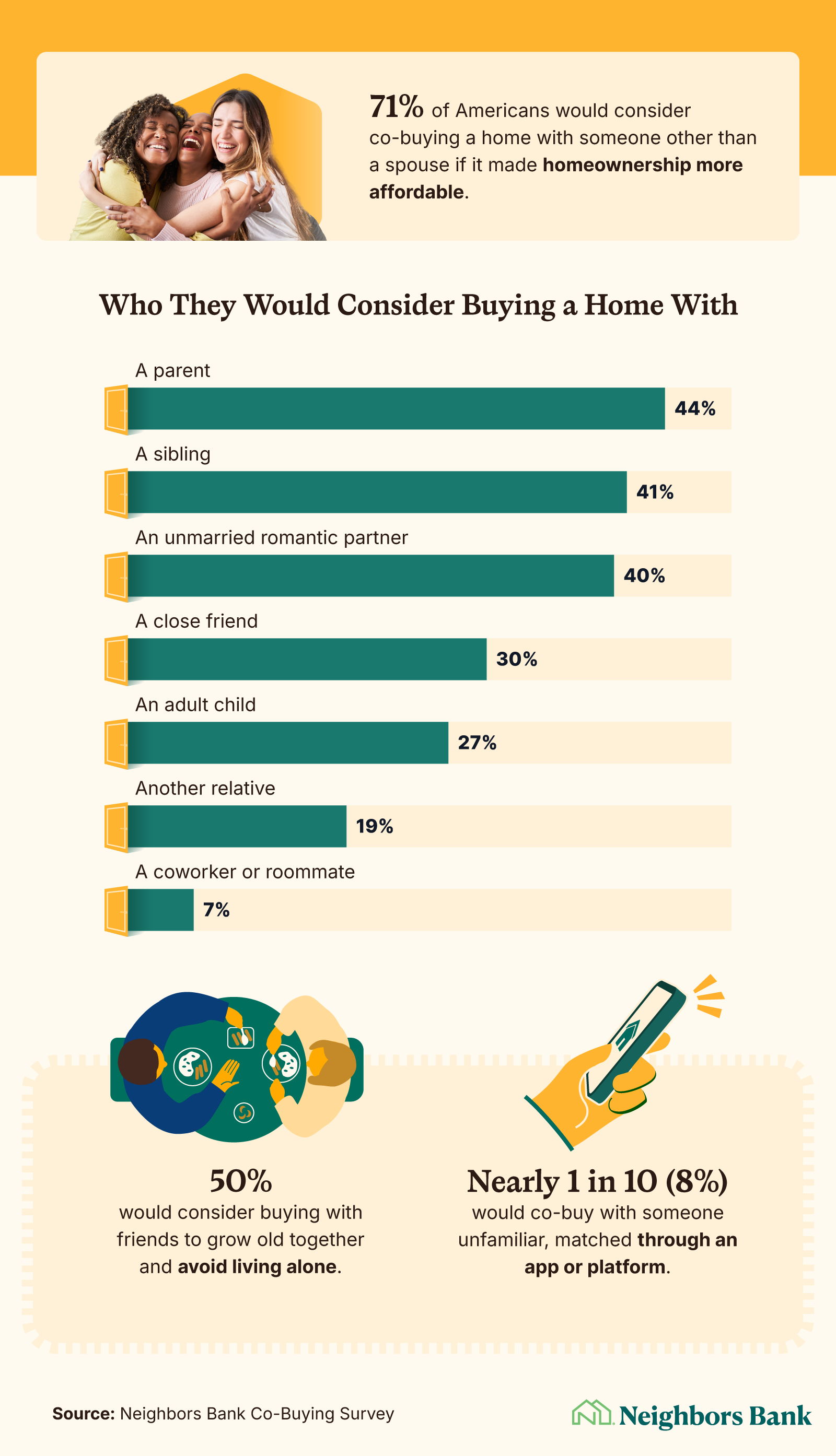
About 7 in 10 Americans (71%) would consider co-buying a home with someone other than a spouse if doing so made homeownership more affordable. Parents were the most common choice at 44%, followed by siblings (41%) and unmarried romantic partners (40%).
Overall, about 2 in 3 Americans (68%) would consider buying with at least one family member, including a parent, sibling, adult child, or another relative. Women were also more likely than men to consider buying with an adult child (33% vs. 20%).
Close friends were another option for 30% of Americans, with interest highest among younger adults. Nearly half of Gen Z respondents (45%) would consider buying with a close friend, compared with 26% of millennials, 25% of Gen X, and 24% of baby boomers. Income also made a difference. Americans earning under $50,000 were about twice as likely to consider buying with a close friend as those earning $100,000 or more (38% vs. 19%).
Some Americans were even open to buying with friends as part of a longer-term living arrangement. Half (50%) would consider co-buying with friends to grow old together and avoid living alone later in life. Buying with someone unfamiliar was much less common, with only 8% saying they would consider co-buying with a stranger matched through an app or platform.
Affordability, Not Wealth, Drives Interest in Co-Buying
For most Americans, the appeal of co-buying comes down to affordability rather than long-term wealth-building. Asked what would most attract them to sharing a purchase, respondents pointed overwhelmingly to easing the cost of buying.
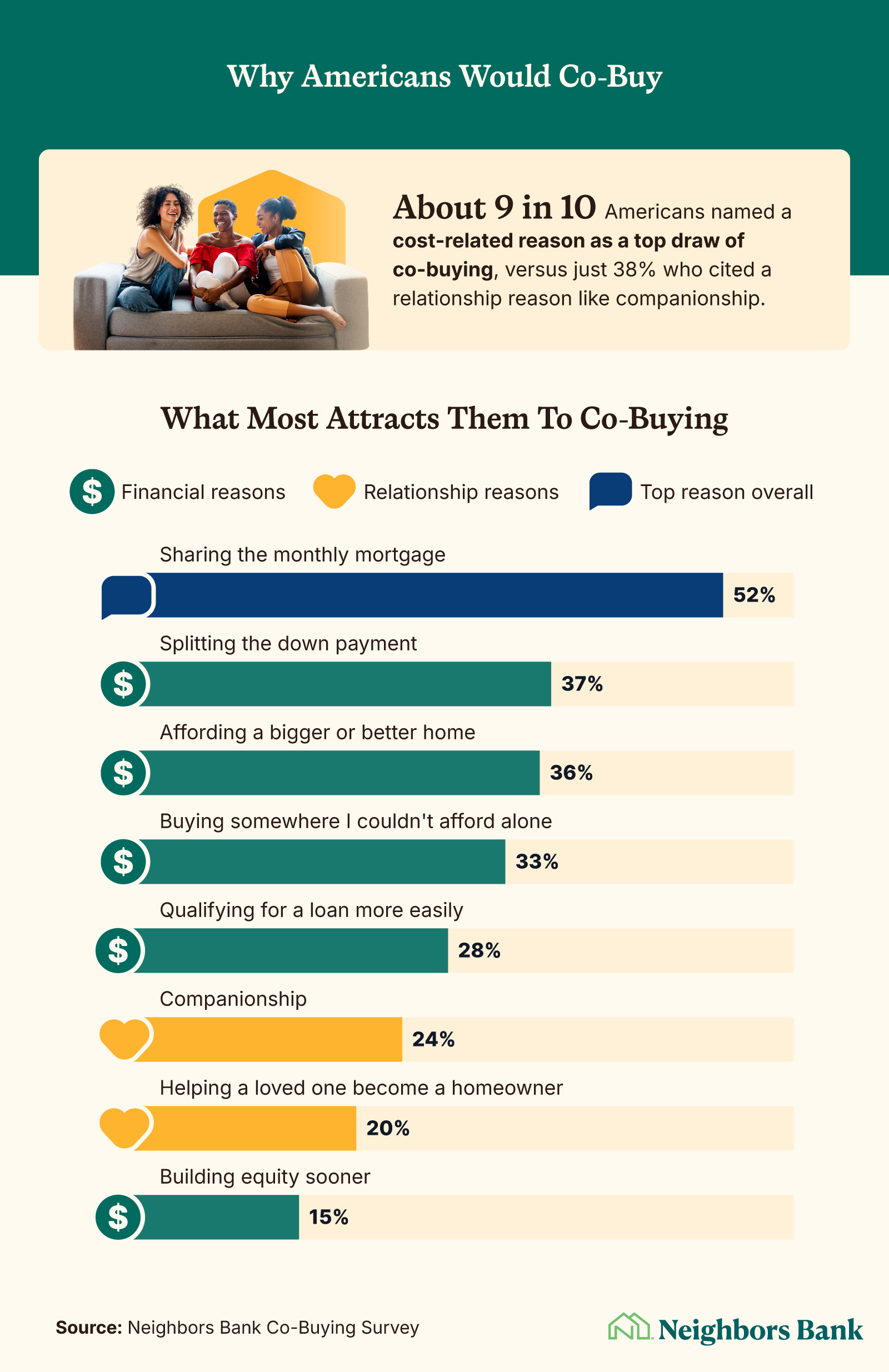
About 9 in 10 Americans (94%) named at least one cost-related reason as a top draw of co-buying. Sharing the monthly mortgage payment led at 52%, followed by splitting the down payment (37%) and affording a bigger or better home (36%). Respondents could select more than one reason.
Relationship reasons drew fewer people. Companionship appealed to 24%, and 20% wanted to help a loved one become a homeowner.
Building equity sooner ranked last, chosen by just 15%. That points to co-buying being seen as a way to make buying affordable now, more than a strategy for building wealth.
Many Americans Would Rather Own a Home Now
For some Americans, sharing ownership may feel more appealing than waiting until they can afford an entire home on their own. The survey also found that attitudes about co-buying varied by income, relationship status, and age.
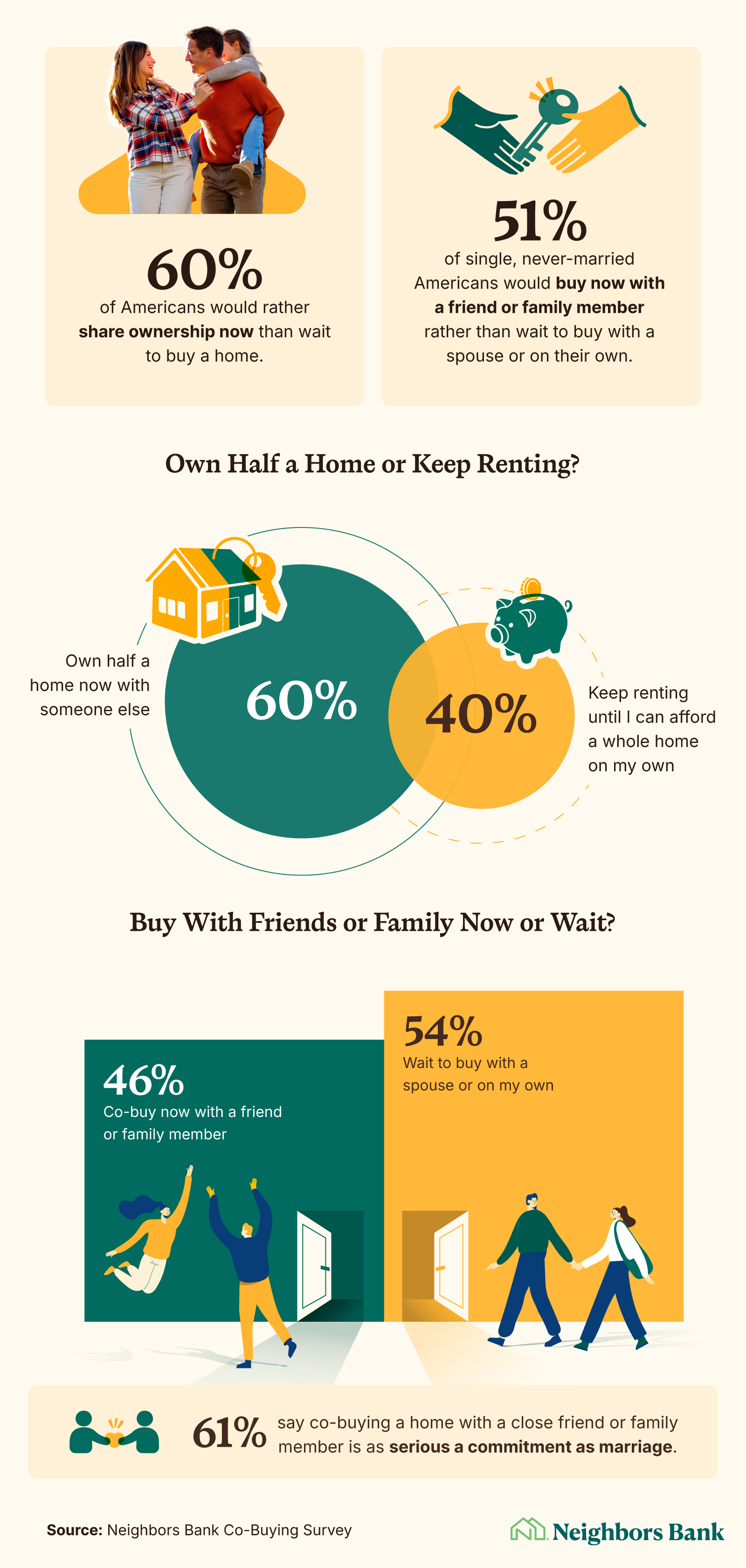
Not everyone viewed co-buying in only positive or negative terms. Nearly 1 in 3 Americans (30%) described it as both a smart financial strategy and a last resort. When given a direct choice, 3 in 5 Americans (60%) said they would rather co-buy and own half of a home now than keep renting until they could afford an entire home on their own. Among Americans earning under $50,000, 51% would rather co-buy now, as would 38% of those earning $100,000 or more.
Even among the 40% of Americans who said they would rather rent until they could afford a whole home on their own, 51% would still consider co-buying if it made ownership more affordable.
More than half of Americans (54%) said they would buy a home with a romantic partner before getting married. At the same time, 61% viewed buying with a close friend or family member as a commitment as serious as marriage. By generation, 44% of millennials, 41% of Gen Z, 33% of Gen X, and 21% of baby boomers agreed.
Learning about financing options can be useful before deciding whether co-buying is necessary. Depending on a homebuyer's circumstances and eligibility, options such as FHA loans may make homeownership more accessible for people with less saved or less-than-perfect credit, while eligible rural and suburban homebuyers may qualify for USDA loans, which require no down payment. Down payment assistance may also help some homebuyers reduce the amount they need upfront.
How Americans Would Protect a Shared Home Purchase
Sharing a deed also means sharing financial responsibilities and decisions about what happens if circumstances change. Most Americans said they would want those expectations documented before buying together.
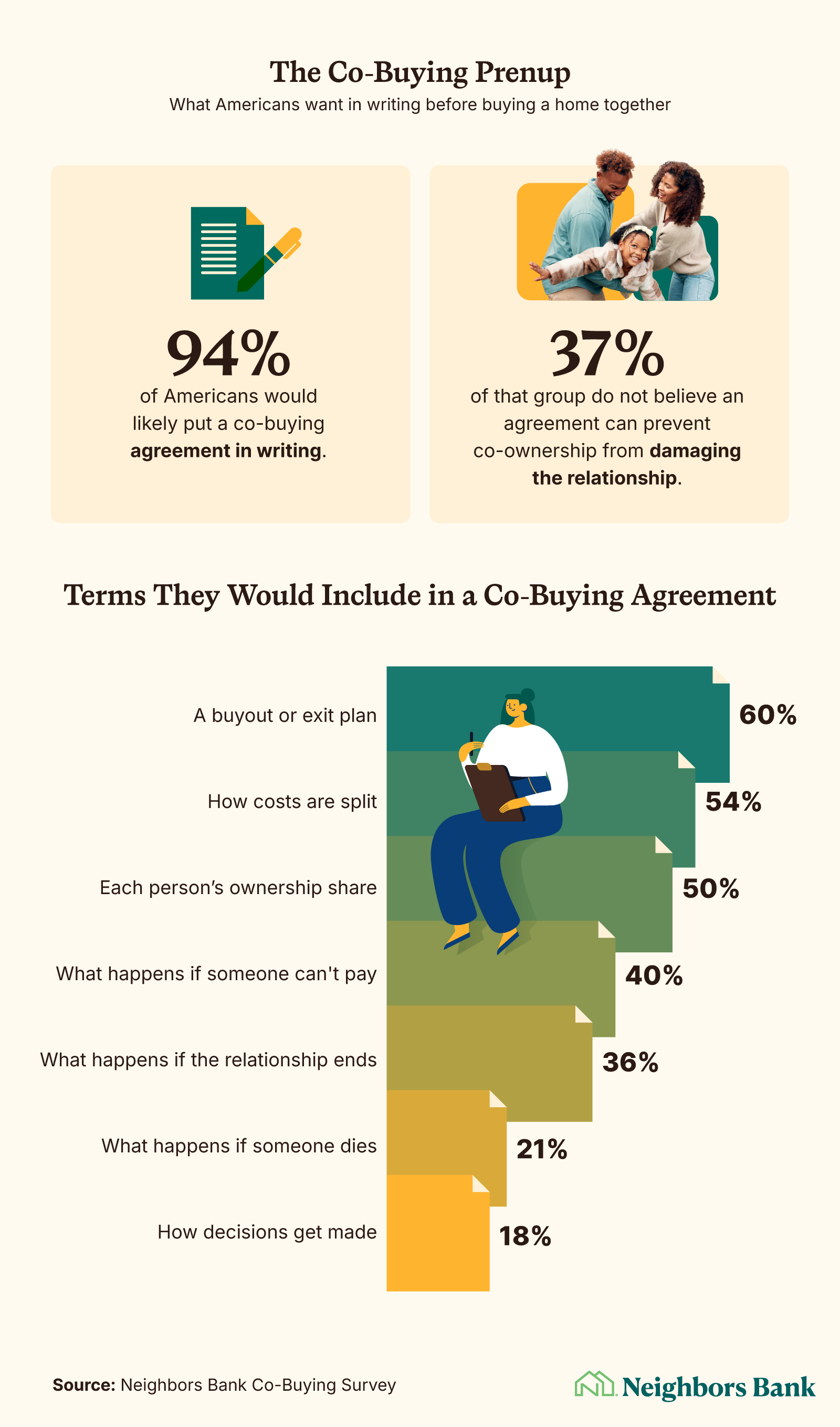
Nearly all Americans (94%) would likely put a co-buying agreement in writing. Nearly three-quarters of married Americans (72%) said they would definitely put a co-buying agreement in writing, compared with 49% of Americans living with an unmarried partner.
When asked what most attracts them to co-buying, Americans pointed to affordability rather than wealth-building. About 9 in 10 (94%) named at least one cost-related reason, led by sharing the monthly mortgage payment (52%) and splitting the down payment (37%). Relationship reasons drew fewer people: 24% cited companionship and 20% wanted to help a loved one become a homeowner. Building equity sooner ranked last, chosen by just 15%. Respondents could select more than one reason.
Interest in a buyout or exit plan increased with age. Among respondents asked about agreement terms, 52% of Gen Z wanted one, compared with 57% of millennials, 67% of Gen X, and 79% of baby boomers.
Some respondents also wanted an agreement to address more difficult circumstances. More than a third (36%) wanted it to spell out what happens if the relationship ends, while 21% wanted it to address what happens if someone dies. By generation, 19% of Gen Z, 18% of millennials, 24% of Gen X, and 31% of baby boomers wanted the agreement to cover someone's death.
Americans also differed in how much protection they thought an agreement could provide. Those who believed they could afford a home alone were more likely to believe a written agreement could help protect a friendship or family relationship from damage caused by co-owning, at 70% compared with 58% of those who believed they could not afford to buy alone.
Co-Buying Gives Homebuyers Another Option to Consider
The survey shows that many Americans are willing to consider buying with others, not just alone or with a spouse, when affordability is a concern. Yet, co-buying is only one option homebuyers can explore when deciding what fits their finances, relationships, and long-term plans.
Understanding the financing options available can matter just as much as deciding who to buy with. Neighbors Bank's home loan options include several low and zero down payment paths that can make buying more attainable, whether someone buys alone or with a co-buyer. And for those who still need help with upfront costs, down payment assistance can reduce, or in some cases fully cover, the down payment and closing costs. Comparing these options can help homebuyers see what they may qualify for before deciding whether co-buying is the right move.
There is no single path that will work for every homebuyer. Comparing financing options, understanding the tradeoffs, and discussing expectations in advance can help people decide whether buying alone, with a spouse, or with a co-buyer makes the most sense for their circumstances.
Methodology
Neighbors Bank surveyed 1,014 American adults ages 18 and older on September 3, 2026, to understand how they view buying a home with someone other than a spouse. For this study, co-buying refers to purchasing a home with a friend, family member, unmarried romantic partner, or another person.
Americans surveyed were asked whom they would consider buying with, whether they would prefer shared ownership now or wait to buy alone or with a spouse, how they compare the commitment of buying together with marriage, and what they would want a written co-buying agreement to cover. Their answers reflect their own beliefs about affordability and hypothetical homebuying choices, rather than verified financial qualifications or actual purchases.
Generationally, 23% were Gen Z, 47% were millennials, 24% were Gen X, and 7% were baby boomers. Generation labels were based on reported age, and percentages may not total 100% because of rounding.
About Neighbors Bank
Neighbors Bank believes homeownership should be affordable, accessible, and achievable for everyone. The lender is licensed in all 50 states and offers home loan options that can cover up to 100% of the down payment and closing costs, helping homebuyers explore options even when upfront savings are a concern.
Fair Use Statement
This content may be shared for noncommercial purposes only with proper attribution to Neighbors Bank. When referencing or reposting these findings, please include a link back to this page.